


Balancing development and ecology in Penang’s southern waters
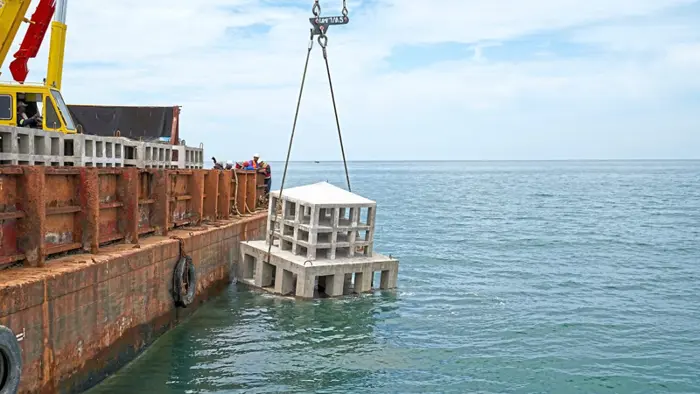

A PROJECT developer has completed a large-scale fish and prawn restocking programme in collaboration with researchers from Centre for Marine and Coastal Studies (Cemacs), Universiti Sains Malaysia.
The initiative by Silicon Island Development Sdn Bhd (SIDSB) involved the release of 25,000 seabass juveniles (Lates calcarifer) and 52,000 tiger prawn juveniles (Penaeus monodon) at strategic locations around Penang this year.
Cemacs director Prof Datuk Dr Aileen Tan said seabass juveniles were released near Pulau Kendi, where artificial reefs were deployed in April.
The release was carried out in four phases between May and August.
“These habitats are critical as they provide shelter, food and breeding grounds, allowing the juveniles to survive and reach maturity,” she said.
“Under natural conditions, male seabass typically mature at around 60cm, and females at about 80cm.
“We are seeding the next generation of healthy fish stocks.”
For prawn restocking, Tan said the team focused on mangrove areas at Kuala Jalan Baru and Kuala Sungai Pinang in Balik Pulau, highlighting that mangroves functioned as natural nurseries rich in nutrients, which also offered protection from predators.
The prawn releases were conducted in five phases, from February to July.
“The tiger prawn was selected because it is the least abundant shrimp species in Balik Pulau.
“By focusing on the most vulnerable species, we strengthen the ecosystem,” said Tan.
“Juvenile tiger prawns weighing 20g to 30g were released.
“They are expected to reach maturity in six to eight months, growing beyond 50g, with a carapace length of about 4cm.”
SIDSB is a joint venture between Penang government via Penang Infrastructure Corporation (PIC), and SRS PD Sdn Bhd, a subsidiary of Gamuda Bhd.
The company is tasked with developing Silicon Island – a 931ha project at the southern tip of Penang island.
Silicon Island is envisioned as a low-carbon smart city centred on high-tech industries, green technology, sustainable living and long-term economic growth.
The development will integrate industrial zones, commercial hubs and residential areas within a planned green ecosystem.
In April, 20 artificial reefs – resembling miniature, unfinished condominiums – were deployed off Pulau Kendi as part of efforts to restore marine life and ecosystems in the southern waters of Penang.
Each reef weighed between nine and 21 tonnes, comprising two large units and 18 smaller ones.
The deployment initiative was jointly undertaken by PIC, SIDSB and Cemacs under the Penang South Islands (PSI) Ecology Offset Masterplan (PEOM).
Tan said, “You can build, but you must also replenish. You can modernise, but you must also remember tradition.
“The challenge is to do both. What we are seeing in Penang is an attempt to balance development and ecology, not by chance, but by design.
“As Penang moves forward with its largest coastal transformation, the challenge is in how communities and ecosystems move forward with it.”
PIC chief executive officer Datuk Seri Farizan Darus said besides strengthening marine stocks, SIDSB was also providing new boats and engines to fishermen under the Social Impact Management Plan (SIMP).
To date, 127 fishermen operating in the vicinity of the project have benefitted.
SIDSB also provided fishermen and aspiring seafarers with a seven-day course conducted by Akademi Maritim Penjana Ilmu that covered chartwork, seamanship, meteorology and lifesaving appliances.
“We want to ensure that while progress continues, traditional communities like fishermen are empowered to adapt and benefit from new opportunities,” said Farizan.
“This includes providing them access to proper training, certification pathways and alternative sources of income.”
He said with sturdier boats, fishermen would be able to fish farther and more safely.
“You cannot simply provide boats without skills, or skills without sustaining the resource base. Sustainability means putting these pieces together.
“SIMP addresses the social dimension by ensuring fishermen can work safely, continue their traditions, or pursue new opportunities.
“PEOM addresses the ecological foundation by ensuring the sea itself continues to provide.”