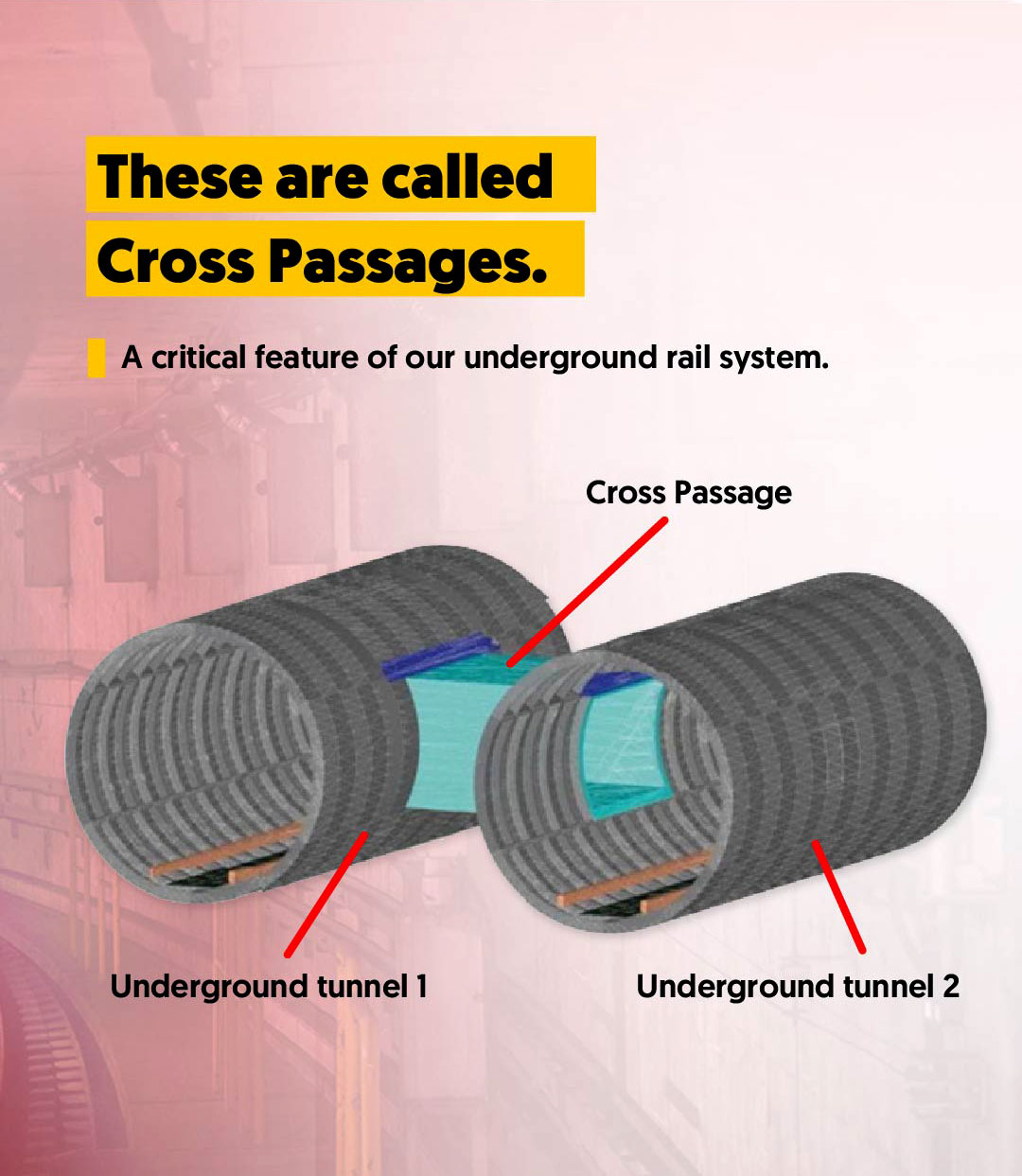
If you’ve ever travelled on a Mass Rapid Transit (MRT) or Light Rail Transit (LRT) train, you probably didn’t think about what lies between the two tunnels running beneath your feet. Hidden from view are small but mighty structures called Cross Passages, which are short links connecting one tunnel to another, critical to keeping passengers safe during an emergency.
What Exactly Are Cross Passages?
Think of them as “side doors” between two parallel tunnels. During daily operations, they’re used for maintenance access and to house important systems such as electrical and signalling equipment. However, during an emergency, they become the safest and fastest escape route, allowing people to move from an affected tunnel to a safe one.
The Big Question: How Far Apart Should They Be?
The National Fire Protection Association (NFPA) 130 recommends placing them every 244 metres (about the length of two football fields). Malaysia’s metro systems follow this, but as technology improves and cities grow, engineers began asking a simple yet important question:
“Can we increase the spacing, and still keep people safe?”
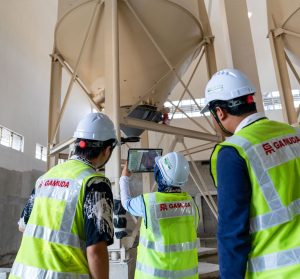
This conversation sparked a study led by Ir. Kanagaprakasam Rasaretnam, Senior Mechanical and Electrical Manager at Gamuda Engineering. The study was recently featured in the Institution of Engineers, Malaysia (IEM)’s Jurutera bulletin. Since joining in 2012, Kanagaprakasam has been involved in major rail projects, including the MRT Kajang Line. He now supports various tenders in Australia.
Why Consider Wider Spacing?
Stretching the gap to 375 metres or more (approximately three and a half football fields) can bring clear benefits: resource efficiency, fewer ground disruptions, easier maintenance and a cleaner tunnel layout.
“But all of that only matters if passengers remain just as safe,” Kanagaprakasam emphasises.
Testing the Safety Gap
To make sure wider spacing wouldn’t put lives at risk, the team carried out safety calculations based on a fire emergency involving 1,200 passengers.
The Safety Rule: The time it takes for people to get out (Time Needed) must be shorter than the time the tunnel stays safe (Time Available).
Evacuation Performance: Standard vs. Proposed
Feature
Standard (244m)
Proposed (375m)
Safety Limit
Time to reach nearest exit
17.1 mins
22.2 mins
30 minutes
Time to reach nearest station
75.6 mins
79.4 mins
120 minutes
Safety Result
✅ Safe
✅ Safe
PASS
The Verdict: Even though the exits are further apart, passengers can still reach safety well within the recommended time limits. The difference in travel time is only a few minutes.
“In simple words, wider spacing still works. You can be efficient and safe,” says Kanagaprakasam.
The study by Kanagaprakasam suggests that this standard 244 metres can be extended to 375 metres.
Learning From Global Practices
Countries such as Switzerland, Germany, Australia and the UK have already adopted wider spacing, sometimes up to 500 metres, supported by robust modelling, system assurance and safety frameworks. As design-and-build contractors, we should review this approach and present it to the Authority Having Jurisdiction (AHJ) for consideration, with the aim of applying it to enhance future metro projects.
The Bigger Picture
At its heart, tunnel design is not just about engineering. It’s about people. It’s about making smart, data-backed decisions that balance safety, cost, practicality and long-term sustainability.
As Kanagaprakasam puts it, “Our job is to question, test, and improve to ensure every system we build is safer and better than the last.”
This study demonstrates how we continue to deliver infrastructure that’s efficient, safe, cost- effective without comprise the safety.
Yen So’s park and lakes blend urban regeneration with masterful township planning.
Today, if you visit it, you could never imagine what it looked like a decade ago.
We use tracking technologies to collect data relating to you to perform analytics, provide you with tailored content and ads based on your interactions on this and other sites or apps and allow you to share content on social media. By clicking on [Accept] you consent to this and to the sharing of this data with our partners. You can change your mind at anytime. Click here to find out more about our practices.
You can choose which analytical, functionality and targeting cookies we can set by clicking on the button(s):
However, if you use your browser settings to block all cookies (including strictly necessary cookies) you may not be able to access all or parts of our website.